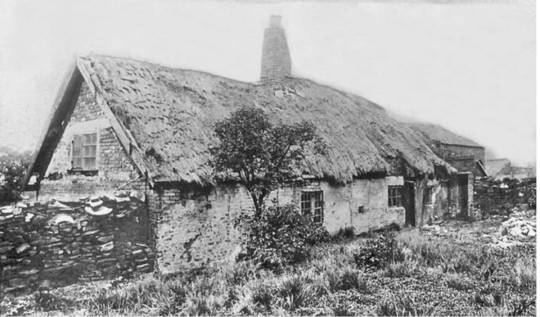
Molly Leigh’s cottage. Demolished some time in the 1880s.
Burslem in Stoke-on-trent is not an enchanted place. It is, I think it’s fair to say, thoroughly disenchanting. The industrial revolution came with it’s china clay and its firing kilns and its rows of narrow, overcrowded terraces, and sooted up the magic, leaving it buried under ash, potsherds and urban sprawl. But once upon a time Burslem marked the threshold between the forest and the moors, a place of fertile farms on rich creamy clay and plentiful springs. And witches.
Molly Leigh, North Staffordshire’s most famous witch, lived in a cottage in a forest on the edge of Burslem, which is a pretty perfect start to a folktale. Born around 1685, she started to establish her witchy credentials very early by virtue of being able to eat ‘hard crusts’ at only a few hours old, and her preference for suckling animals instead of her own mother’s milk. Which, to be fair, would cause a stir.
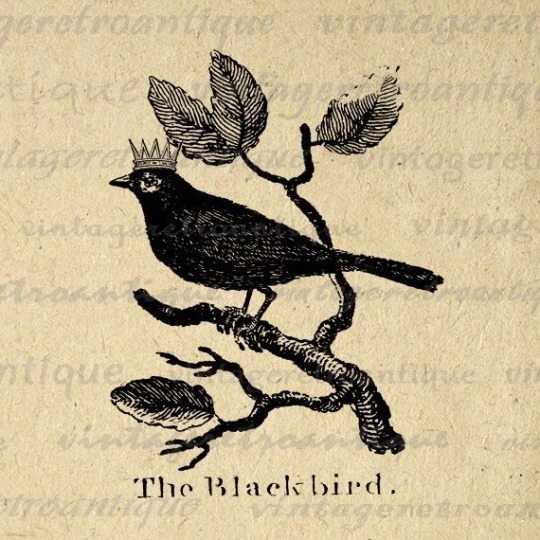
She went on to further disrupt the 17th Century idea of normal by remaining unmarried, being extremely ugly, refusing to go to church, and indulging in, what seems to be, some classic trolling of the local vicar, Rev. Thomas Spencer (a notorious drunk, with no sense of humour). Oh, and she had a pet blackbird, who she conversed with regularly and was considered her closest associate. All of which makes me want to friend her on Facebook immediately.
The Reverend, however, probably wouldn’t have sent that friend request, as he was her chief accuser of witchcraft; although the whole blackbird familiar wouldn’t have helped. Ms. Molly Leigh responded to this accusation by sending her blackbird to sit on the sign of his favourite pub, The Turk’s Head, which, according to the Rev. made the beer instantly sour and caused the angry inebriate to take to his bed with dreadful and prolonged stomach cramps*. In a fit of revenge, not only did he try to shoot the poor bird, but he also accused Molly of causing him to be drunk for three weeks straight. Yes, it was definitely the witchcraft and definitely not the alcoholism. Case closed.
Despite the bloodshot rantings of the gun toting pastor, Molly Leigh lived a long(ish) life and died of natural causes around 1746. She was buried in St John’s churchyard in Burslem. Her blackbird outlived her, staying close to her cottage and clearly irking the neighbours. Enter the unsteady Reverend once more, bearing a grudge and not completely sober, he decided to break into Molly’s cottage and catch that darn bird, only to witness the ultimate beyond-the-grave trolling move: Molly Leigh sitting in her rocking chair by the hearth, chilling with her blackbird. The Rev. and his band of doughty men fled in terror.
And now I want to follow her on Instagram, Twitter and Snapchat.
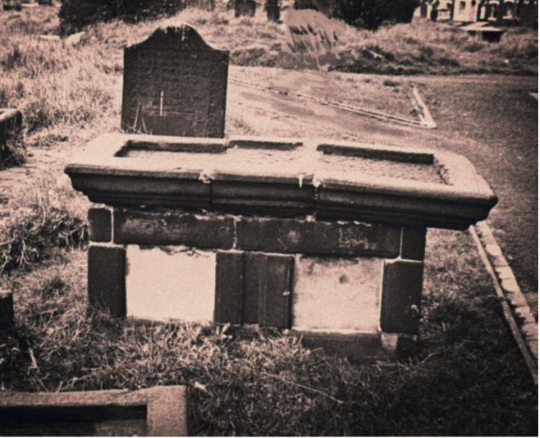
Molly’s tomb in St John’s churchyard.
The Reverend, now convinced he was being haunted by the Witch, brought in three vicars from the surrounding areas to help him subdue her feisty spirit. Four Revs to deal with one Molly Leigh. They caught her blackbird, opened her tomb, some say drove a stake through her heart, and then interred the poor bird with her dead mistress. They also moved her tomb so it lay in a north-south alignment and not a christianly east-west. The witch now subdued, the Rev. went on a huge bender and had blackbird nightmares for the rest of his short angry life. (Not a part of the original story, but my personal addition to the canon).
However, what makes Molly Leigh’s story particularly compelling is the fascinating mixture of classic folklore embroidery and hard documentary evidence. She existed. We have a photograph of her home, which was still standing in the late 19th century, and we have the paperwork: her Will has recently entered the public domain, and tells a story tantalisingly close to the folk tale.
Molly Leigh was single, had a blackbird/ black bird familiar, lived on her own and was hounded by the local vicar for her refusal to attend church, but what the folk tale doesn’t reveal is that Mistress Leigh was a single and successful business woman and landowner. She sold milk and dairy products, was a hay and straw trader, and even, according to some accounts, ran a sort of village savings bank. She owned not only her house, but houses and land in Staffordshire and Cheshire. She was a working class, powerful, single woman whom the church could not touch; a rare find for those times. Cue the impotent rage of the local clergy.
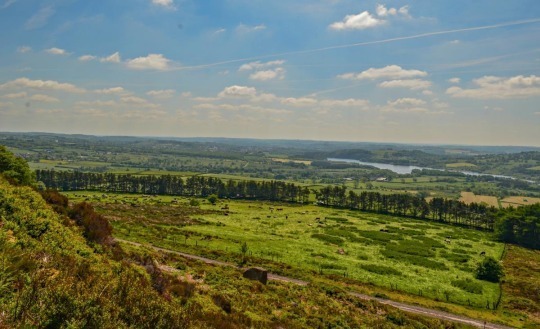
North Staffordshire moorlands. Photo by Baldhiker.
Her legendary status of solitary witch, although necessary for the purpose of storytelling, was it seems, untrue. She may have lived alone and in a fairly isolated cottage but her Will illuminates her worldly connections, and they are all women. She’d previously provided her best friend Alice Beech (perfect name), with a house and land, and not only was this left to Alice in the Will, but a stipend provided to secure Alice’s future and the future of her descendants. She did the same for her mother, aunt and cousins, but excluded, in the strongest possible terms, her step-father (although he is called father-in-law in the will), Joseph Booth:
“I do hereby expressly order and declare that Mr Joseph Booth, my father-in-law, shall have nothing to do with the rents and profits of the said lands but is hearby utterly excluded and debarred,”
Um, not a fan then.
She also ensured that the money she left to her cousin Ann was protected from Ann’s husband. A bold and progressive move at a time when men automatically controlled their wives’ finances.
She also left money enough for Alice Beech to buy forty six-penny loaves each year to feed the “poor inhabitants and widows of Sneyd and Burslem”. Her work for the good women of Burslem did not end there. On the death of her mother, aunt and cousins, she instructed her solicitor to sell her remaining estate and build a hospital for the “reception and habitation of the poor women of Burslem” and to provide them with food and clothes.
Yes. An 18th century witch built, what was probably, North Staffordshire’s first women’s shelter.
And Molly Leigh’s legend lives on. In recent times, 1979, 1987 and 1989, there have been various schemes to renovate the 16th century churchyard of St John, and even remove the churchyard for the expansion of the main road. One hundred and seventeen headstones were eventually moved and the remains re-interred elsewhere, but Molly’s tomb was left undisturbed. Her legend remaining so strong that many of the men selected for the job declined to undertake the work.
Even today, the story of Molly Leigh is passed down to the next generation, and in a truly classic homage to this iconic local witch, she even has her own spooky rhyme, to be said three times as you circumambulate her uncanny tomb:
“Molly Leigh, Molly Leigh, chase me round the apple tree,
Molly Leigh, Molly Leigh, you can’t catch me,
Molly Leigh, Molly leigh, chase me down all the holes I can see.”**
So here’s to Molly Leigh: business woman, philanthropist, feminist icon and blackbird witch.
All genders, sexes, and identites are welcome in Waincraft. This tradition is pro-trans, pro-queer, pro-woman.
We recognize the importance of the alignment of body and soul, and believe that all persons are unique and valuable in exactly the way(s) they wish to be. We do not believe in reductionist biology, evolutionary pop-psychology, or any other method by which a human may attempt to justify the dehumanization and oppression of another.
We do not welcome TERFs, SWERFs, MRAs, queerphobes, or fucking Nazis and white supremacists. They are barred from this tradition and these Mysteries, because to receive the knowledge and understanding of this work, one must be able to acknolwedge the worth of *all*.
“Bees are the smallest of birds. They are born from the bodies of oxen, or from the decaying flesh of slaughtered calves; worms form in the flesh and then turn into bees. Bees live in community, choose the most noble among them as king, have wars, and make honey. Their laws are based on custom, but the king does not enforce the law; rather the lawbreakers punish themselves by stinging themselves to death. Bees are afraid of smoke and are excited by noise. Each has its own duty: guarding the food supply, watching for rain, collecting dew to make honey, and making wax from flowers.”
“One should always be drunk. That’s all that matters; that’s our one imperative need. So as not to feel Time’s horrible burden that breaks your shoulders and bows you down, you must get drunk without ceasing.
But what with? With wine, with poetry, or with virtue, as you choose. But get drunk.
And if, at some time, on the steps of a palace, in the green grass of a ditch, in the bleak solitude of your room, you are waking up when drunkenness has already abated, ask the wind, the wave, a star, the clock, all that which flees, all that which groans, all that which rolls, all that which sings, all that which speaks, ask them what time it is; and the wind, the wave, the star, the bird, the clock will reply: ‘It is time to get drunk! So that you may not be the martyred slaves of Time, get drunk; get drunk, and never pause for rest! With wine, with poetry, or with virtue, as you choose!‘” – Charles Baudelaire, tr. Michael Hamburger”
When you’re trying to ask your deck a question, but instead of answering the question the cards just tell you you’re being a little bitch.



 woolandcoffee